

Attending the Engage Customer Summit earlier this month, the recurring theme across the panel discussions and exhibitor product demos was crystal clear: whatever tool or platform you decide to use, you cannot forget about the most important thing — and that is the human touch.
It was profoundly refreshing to witness, particularly in this dauntingly saturated 2026 marketplace where there is an online software solution and subscription for every challenge your business is facing when it comes to customers.
This is even more true with video. At the event, the whole concept of ‘AI-generated video’ is now too broad and generic. We saw several examples of AI-driven platforms that are specifically built to create personalised videos for each individual customer.
While these tools offer impressive technical utility, a period of reflection brought up a critical question: Which markets are these tools actually built for—Business-to-Consumer (B2C), Business-to-Business (B2B), or both? Further, what does it mean for SME organisations overall?

Lots of cutting edge, technological, and AI agentic innovation at the Engage Customer Summit
Understanding the difference between B2C & B2B video markets
Seen are a good example of ‘personalised video’ at mass scale. Furthermore, they are great example of a video tool that is specifically targeting B2C brands. According to McKinsey, 71% of consumers expect personalised interactions, and brands that excel at data-driven B2C personalisation generate significantly higher revenue.
Basically, brands want to get in front of their consumers en masse, as regularly as they can, as cost-effectively as they can, and as ‘personally’ as they can. So tools like this are a good option.
But when it comes to B2B marketing, it’s a whole different story.
Research from Edelman and LinkedIn shows that business buyers don’t trust mass-produced, automated outreach. When a lot of money and risk is involved, and several people have to sign off, buyers want to feel someone actually put effort in. They can spot tricks like auto-inserted names or AI-generated avatars straight away, and they see them as lazy sales gimmicks.

Even the general public are getting fed up with “AI slop.” Imagine what your customers think….
What B2B leaders and executives consistently say earns their trust—and ultimately their business—is authentic thought leadership and real human expertise. In short, the two markets are looking for completely different styles of video content. The table below provides a summary of the differences (and similarities) between the two markets.

Bridging the Gap: The Inside Edge Mobile-First Video Edge
So, while B2C and B2B markets require completely different engagement strategies, traditional video production fails them both for the exact same reason: it’s too inauthentic, it’s too rigid, it’s too disconnected from your modern customer and audience. Even though it might be human-made, the third party agencies are still in control of the narrative, not you. YOU need to tell your stories now, not the Creative Director.
This is why our Mobile-First Video Edge™ addresses and bridges the gap in between.
Through our adaptable on-site training day sessions, we educate, demonstrate, coach, encourage, support, and inspire your leaders, experts, and internal teams how to capture their personal knowledge and stories on camera using only their mobile phones…and a little imagination.
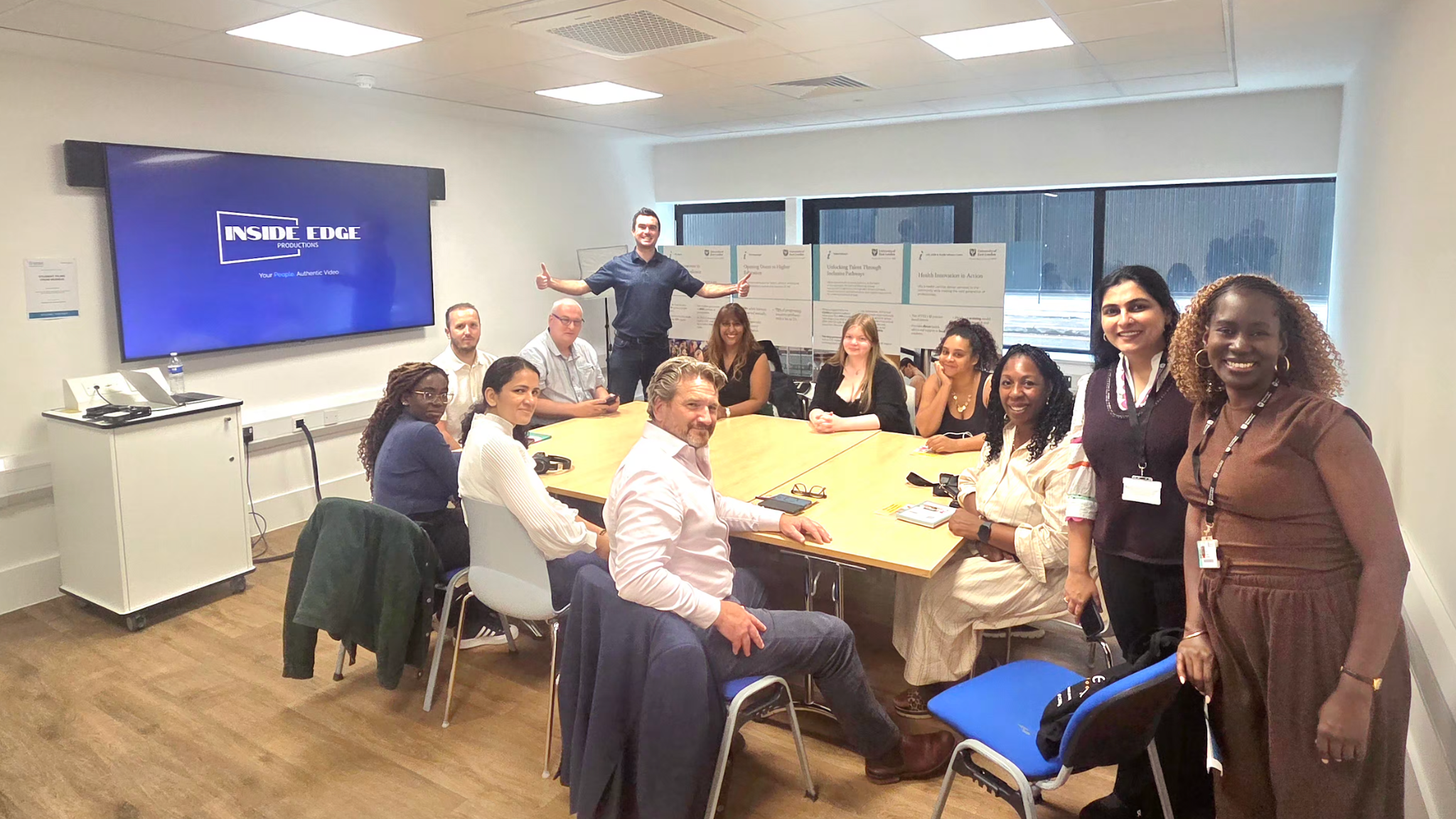
Inside Edge running a mobile-video workshop at University of East London for business founders.
We turn your organisation into an agile, self-sufficient video engine — giving you the ability to produce highly-flexible, highly-focused, market-ready, authentic video whenever and wherever expertise needs to be shared.
We have no pitch, no product, no platform, and no packages to sell you. What we offer is an edge.
A human edge. A competitive edge. Your Mobile-First Video Edge™.